原文逐句译读与注释按原站顺序
Chapter 10: Multi stage amplifier configurations本节译题:Chapter 10: Multi stage amplifier configurations
原句For most systems a single transistor amplifier does not provide sufficient gain or bandwidth or will not have the correct input or output impedance matching.
中文译读逐句译读:这句话围绕 单管放大级、阻抗、带宽 展开;核心是在说明这些量/结构之间的定义、作用或约束关系。
补充注释单管放大级:用一个 BJT 或 MOSFET 形成基本增益级、缓冲级或电流输入级。;阻抗:交流中电压与电流的复数比,包含电阻和电抗。;带宽:满足指定增益/误差条件的频率范围。。
原句The solution is to combine multiple stages of amplification.
中文译读逐句译读:这是一句上下文说明,建议与前后句连读,用来补全本节的概念背景或推导条件。
补充注释学习提示:先确认这句话是在给定义、列条件、还是给结论;电路题里最常见的错误是跳过适用条件直接套公式。
原句We have the three basic one transistor amplifier configurations to use as building blocks to create more complex amplifier systems which can provide better optimized specifications and performance.
中文译读逐句译读:这是一句上下文说明,建议与前后句连读,用来补全本节的概念背景或推导条件。
补充注释学习提示:先确认这句话是在给定义、列条件、还是给结论;电路题里最常见的错误是跳过适用条件直接套公式。
原句The sections in this chapter tend to use BJT devices to illustrate the circuit concepts but these multi-stage amplifiers can be constructed from MOS FET devices, or a combination, just as easily and the methods used to analyze them are much the same as well.
中文译读本句在说明本章范围:相关基础概念;阅读时应把它当作本章学习路线,而不是孤立结论。
补充注释学习提示:先确认这句话是在给定义、列条件、还是给结论;电路题里最常见的错误是跳过适用条件直接套公式。
图片未下载:university:courses:electronics:text:chptr10_f1.png
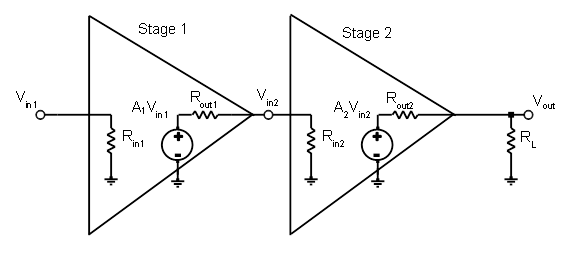
原句Figure 10.1 Two stage cascade amplifier
中文译读逐句译读:这是一句上下文说明,建议与前后句连读,用来补全本节的概念背景或推导条件。
补充注释学习提示:先确认这句话是在给定义、列条件、还是给结论;电路题里最常见的错误是跳过适用条件直接套公式。
原句It is necessary to consider what happens when non-ideal amplifiers are put in series.
中文译读逐句译读:这是一句上下文说明,建议与前后句连读,用来补全本节的概念背景或推导条件。
补充注释学习提示:先确认这句话是在给定义、列条件、还是给结论;电路题里最常见的错误是跳过适用条件直接套公式。
原句Looking at the example in figure 10.1, it is clear that the input and output resistances (or impedances) come into play by reducing the overall gain.
中文译读逐句译读:这句话围绕 输出电阻、阻抗、电阻 展开;核心是在说明这些量/结构之间的定义、作用或约束关系。
补充注释输出电阻:从输出端看进去的等效电阻,决定增益、负载效应和电流源理想程度。;阻抗:交流中电压与电流的复数比,包含电阻和电抗。;电阻:耗散能量并限制电流的元件参数。。
原句If the amplifiers were ideal (R<sub>out</sub> = 0 and R<sub>in</sub> = ∞), and amplifier stages #1 and #2 had gains of A<sub>1</sub> and A<sub>2</sub>, the overall gain would simply be A<sub>1</sub>*A<sub>2</sub>.
中文译读逐句译读:这是一句上下文说明,建议与前后句连读,用来补全本节的概念背景或推导条件。
补充注释学习提示:先确认这句话是在给定义、列条件、还是给结论;电路题里最常见的错误是跳过适用条件直接套公式。
原句For the above example, let us now calculate the gain assuming nothing about the R<sub>in</sub> and R<sub>out</sub> of each stage, treating them as voltage dividers between the two stages and between the last stage and the output load.
中文译读逐句译读:这是一句上下文说明,建议与前后句连读,用来补全本节的概念背景或推导条件。
补充注释学习提示:先确认这句话是在给定义、列条件、还是给结论;电路题里最常见的错误是跳过适用条件直接套公式。
原句Note that in practice, impedances, Z<sub>in</sub>, Z<sub>out</sub>, would normally be used, not resistances, but the simple resistance will serve to illustrate the point here.
中文译读可译为“但是/然而……”。本句在提醒限制或例外:即使涉及 阻抗、电阻,也不能无条件套用前一句结论。
补充注释阻抗:交流中电压与电流的复数比,包含电阻和电抗。;电阻:耗散能量并限制电流的元件参数。。
原句First amplification stage with loss between stage #1 and #2: <m> V_in2=A_1 V_in1 (R_in2/(R_in2+R_out1 )) </m> Second amplification stage with loss due to R<sub>out2</sub> and R<sub>L</sub>: <m> V_out=A_2 V_in2 (R_L/(R_L+R_out2 )) </m> Overall gain equation: <m> V_out/V_in =?A_1 A?_2 (R_in2/(R_in2+R_out1 ))(R_L/(R_L+R_out2 )) </m>
中文译读逐句译读:这是一句上下文说明,建议与前后句连读,用来补全本节的概念背景或推导条件。
补充注释学习提示:先确认这句话是在给定义、列条件、还是给结论;电路题里最常见的错误是跳过适用条件直接套公式。
原句As we would expect, the overall equation reduces to the ideal case of A<sub>V</sub> = A<sub>1</sub>*A<sub>2</sub> for two ideal stages when we let the R<sub>out</sub> go to 0 and the R<sub>in</sub> go to infinity.
中文译读逐句译读:这是一句上下文说明,建议与前后句连读,用来补全本节的概念背景或推导条件。
补充注释学习提示:先确认这句话是在给定义、列条件、还是给结论;电路题里最常见的错误是跳过适用条件直接套公式。
原句As a matter of fact, we really only need R<sub>out</sub> to go to 0 to have the resistor dividers to go to 1.
中文译读逐句译读:这是一句上下文说明,建议与前后句连读,用来补全本节的概念背景或推导条件。
补充注释学习提示:先确认这句话是在给定义、列条件、还是给结论;电路题里最常见的错误是跳过适用条件直接套公式。
原句The above equations assume that the individual amplifier gains, A do not change with output loading.
中文译读逐句译读:这是一句上下文说明,建议与前后句连读,用来补全本节的概念背景或推导条件。
补充注释学习提示:先确认这句话是在给定义、列条件、还是给结论;电路题里最常见的错误是跳过适用条件直接套公式。
原句That effect, if any, is modeled in the R<sub>out</sub>.
中文译读逐句译读:这是一句上下文说明,建议与前后句连读,用来补全本节的概念背景或推导条件。
补充注释学习提示:先确认这句话是在给定义、列条件、还是给结论;电路题里最常见的错误是跳过适用条件直接套公式。
原句For most integrated circuit amplifiers where R<sub>in</sub> is in the MΩ to GΩ range, and R<sub>out</sub> is in the 50 to 100 Ω range, the gains are pretty close to being the simple product of the gain stages.
中文译读逐句译读:这是一句上下文说明,建议与前后句连读,用来补全本节的概念背景或推导条件。
补充注释学习提示:先确认这句话是在给定义、列条件、还是给结论;电路题里最常见的错误是跳过适用条件直接套公式。
原句To confirm this assertion, assume a low performance op amp with R<sub>out</sub> = 100Ω and R<sub>in</sub> = 1MΩ, what is the gain with two stages of gain A<sub>1</sub> and A<sub>2</sub> in series?
中文译读逐句译读:这句话围绕 运放 展开;核心是在说明这些量/结构之间的定义、作用或约束关系。
补充注释运放:高增益差分放大器;分析时先确认是否处于负反馈线性区。。
原句(assume R<sub>L</sub> = 1 MΩ)
中文译读逐句译读:这是一句上下文说明,建议与前后句连读,用来补全本节的概念背景或推导条件。
补充注释学习提示:先确认这句话是在给定义、列条件、还是给结论;电路题里最常见的错误是跳过适用条件直接套公式。
原句<m> V_out/V_in = A_1 A_2 (1MΩ/(1MΩ+100Ω))(1MΩ/(1MΩ+100Ω))=A_1 A_2 (0.9999)(0.9999) = 0.9998A_1 A_2 </m>
中文译读逐句译读:这是一句上下文说明,建议与前后句连读,用来补全本节的概念背景或推导条件。
补充注释学习提示:先确认这句话是在给定义、列条件、还是给结论;电路题里最常见的错误是跳过适用条件直接套公式。
原句The answer is pretty close to A<sub>1</sub>*A<sub>2</sub>.
中文译读逐句译读:这是一句上下文说明,建议与前后句连读,用来补全本节的概念背景或推导条件。
补充注释学习提示:先确认这句话是在给定义、列条件、还是给结论;电路题里最常见的错误是跳过适用条件直接套公式。
原句In fact, you would have to go to a cascade of 100 stages with these specifications before you even lost 1% of the expected ideal gain (i.e. to get 0.99 A<sup>100</sup>).
中文译读可译为“必须/需要……”。这是约束条件,通常关系到 安全工作范围、精度或稳定性。
补充注释学习提示:先确认这句话是在给定义、列条件、还是给结论;电路题里最常见的错误是跳过适用条件直接套公式。
原句By the time you reached that point, other adverse effects would have caused much more trouble, for example, the fact that noise from each successive stage is added to the noise coming into that stage and is further amplified on down the cascade of amplifiers.
中文译读这是举例说明。例子的作用是把 噪声 落到具体数值、器件或电路情形上。
补充注释噪声:电路内部随机扰动;低噪声设计要分清电压噪声、电流噪声和电阻热噪声。。
原句There are practical reasons why you just can't continue cascading stages "forever..." If DC-coupled, real-world offsets can be impossible to trim out.
中文译读逐句译读:这是一句上下文说明,建议与前后句连读,用来补全本节的概念背景或推导条件。
补充注释学习提示:先确认这句话是在给定义、列条件、还是给结论;电路题里最常见的错误是跳过适用条件直接套公式。
原句Even if AC-coupled, noise from preceding stages gets amplified by each downstream amplifier stage, making for nothing but a noise source after a while.
中文译读可译为“但是/然而……”。本句在提醒限制或例外:即使涉及 噪声,也不能无条件套用前一句结论。
补充注释噪声:电路内部随机扰动;低噪声设计要分清电压噪声、电流噪声和电阻热噪声。。
原句We generally refer all noise to the input of the signal chain, taking out the effects of the gain stages.
中文译读逐句译读:这句话围绕 噪声 展开;核心是在说明这些量/结构之间的定义、作用或约束关系。
补充注释噪声:电路内部随机扰动;低噪声设计要分清电压噪声、电流噪声和电阻热噪声。。
10.1 Cascade of two single transistor stages本节译题:10.1 Cascade of two single transistor stages
原句The impact of input and output loading can be minimized by cascading two amplifiers with appropriate input and output characteristics.
中文译读逐句译读:这是一句上下文说明,建议与前后句连读,用来补全本节的概念背景或推导条件。
补充注释学习提示:先确认这句话是在给定义、列条件、还是给结论;电路题里最常见的错误是跳过适用条件直接套公式。
原句Multistage cascading can be used to create amplifiers with high input resistance, low output resistance and large gains.
中文译读可译为“它可用于/常用于……”。本句强调 输出电阻、电阻 的用途,设计时还要检查适用条件和限制。
补充注释输出电阻:从输出端看进去的等效电阻,决定增益、负载效应和电流源理想程度。;电阻:耗散能量并限制电流的元件参数。。
10.1.1 Common Emitter / Common Collector cascade共射极
原句The cascade of a Common Emitter amplifier stage followed by a Common Collector (emitter-follower) amplifier stage can provide a good overall voltage amplifier, figure 10.1.1.
中文译读逐句译读:这句话围绕 共射极 展开;核心是在说明这些量/结构之间的定义、作用或约束关系。
补充注释共射极:BJT 反相电压增益级,输入在基极、输出在集电极。。
原句The Common Emitter input resistance is relatively high and Common Collector output resistance is relatively low.
中文译读逐句译读:这句话围绕 共射极、输出电阻、电阻 展开;核心是在说明这些量/结构之间的定义、作用或约束关系。
补充注释共射极:BJT 反相电压增益级,输入在基极、输出在集电极。;输出电阻:从输出端看进去的等效电阻,决定增益、负载效应和电流源理想程度。;电阻:耗散能量并限制电流的元件参数。。
原句The voltage follower second stage, Q<sub>2</sub>, contributes no increase in voltage gain but provides a near voltage-source (low resistance) output so that the gain is nearly independent of load resistance.
中文译读可译为“但是/然而……”。本句在提醒限制或例外:即使涉及 电阻,也不能无条件套用前一句结论。
补充注释电阻:耗散能量并限制电流的元件参数。。
原句The high input resistance of the Common Emitter stage, Q<sub>1</sub>, makes the input voltage nearly independent of input-source resistance.
中文译读逐句译读:这句话围绕 共射极、电阻 展开;核心是在说明这些量/结构之间的定义、作用或约束关系。
补充注释共射极:BJT 反相电压增益级,输入在基极、输出在集电极。;电阻:耗散能量并限制电流的元件参数。。
原句Multiple Common Emitter stages can be cascaded with emitter follower stages inserted between them to reduce the attenuation due to inter-stage loading.
中文译读逐句译读:这句话围绕 共射极、射极跟随器 展开;核心是在说明这些量/结构之间的定义、作用或约束关系。
补充注释共射极:BJT 反相电压增益级,输入在基极、输出在集电极。;射极跟随器:电压增益接近 1,但输入阻抗高、输出阻抗低,常作缓冲。。
图片未下载:university:courses:electronics:text:chptr10_f2.png
原句Figure 10.1.1 Common Emitter, Common Collector
中文译读逐句译读:这句话围绕 共射极 展开;核心是在说明这些量/结构之间的定义、作用或约束关系。
补充注释共射极:BJT 反相电压增益级,输入在基极、输出在集电极。。
原句Calculating the DC biasing conditions and the required resistance values for each stage in the cascade is preformed just as we have done in the previous chapter on single stage amplifiers.
中文译读可译为“必须/需要……”。这是约束条件,通常关系到 电阻。
补充注释电阻:耗散能量并限制电流的元件参数。。
原句The effect of inter-stage loading must then be take into account as we just discussed in the opening section of this chapter.
中文译读本句在说明本章范围:相关基础概念;阅读时应把它当作本章学习路线,而不是孤立结论。
补充注释学习提示:先确认这句话是在给定义、列条件、还是给结论;电路题里最常见的错误是跳过适用条件直接套公式。
10.1.2 DC coupled Common Emitter stages共射极
原句Another multi-stage amplifier to explore is to simply cascade two common emitter stages.
中文译读逐句译读:这句话围绕 共射极 展开;核心是在说明这些量/结构之间的定义、作用或约束关系。
补充注释共射极:BJT 反相电压增益级,输入在基极、输出在集电极。。
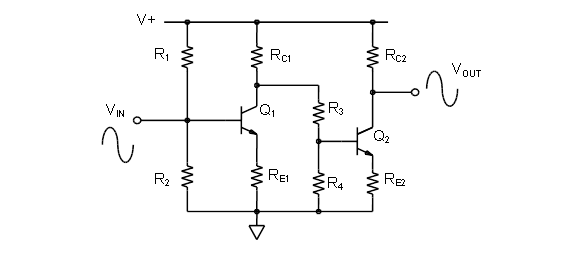
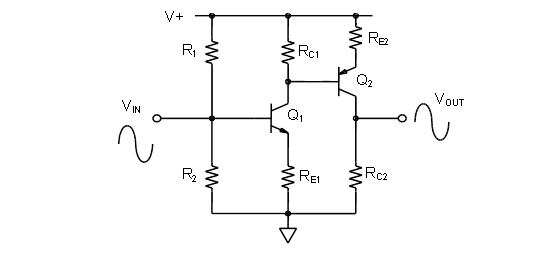
原句Figure 10.1.2 shows two n-type common emitter stages in cascade.
中文译读逐句译读:这句话围绕 共射极 展开;核心是在说明这些量/结构之间的定义、作用或约束关系。
补充注释共射极:BJT 反相电压增益级,输入在基极、输出在集电极。。
图片未下载:university:courses:electronics:text:chptr10_f3.png
原句Figure 10.1.2 DC coupled Common Emitter stages
中文译读逐句译读:这句话围绕 共射极 展开;核心是在说明这些量/结构之间的定义、作用或约束关系。
补充注释共射极:BJT 反相电压增益级,输入在基极、输出在集电极。。
原句The complication in calculating the gain of cascaded stages comes from the non-ideal coupling between stages due to loading.
中文译读逐句译读:这是一句上下文说明,建议与前后句连读,用来补全本节的概念背景或推导条件。
补充注释学习提示:先确认这句话是在给定义、列条件、还是给结论;电路题里最常见的错误是跳过适用条件直接套公式。
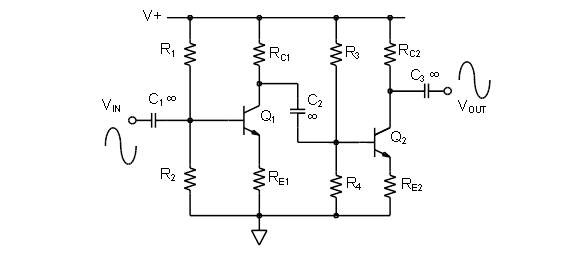
原句Two cascaded common emitter stages are shown in figure 10.1.2.
中文译读逐句译读:这句话围绕 共射极 展开;核心是在说明这些量/结构之间的定义、作用或约束关系。
补充注释共射极:BJT 反相电压增益级,输入在基极、输出在集电极。。
原句Because the input resistance of the second stage (resistors R<sub>3</sub> and R<sub>4</sub>) forms a voltage divider with the output resistance (R<sub>C1</sub>) of the first stage, the total gain is not simply the product of the gain for the individual (separated) stages.
中文译读逐句译读:这句话围绕 输出电阻、电阻 展开;核心是在说明这些量/结构之间的定义、作用或约束关系。
补充注释输出电阻:从输出端看进去的等效电阻,决定增益、负载效应和电流源理想程度。;电阻:耗散能量并限制电流的元件参数。。
原句The total voltage gain can be calculated in either of two ways.
中文译读逐句译读:这是一句上下文说明,建议与前后句连读,用来补全本节的概念背景或推导条件。
补充注释学习提示:先确认这句话是在给定义、列条件、还是给结论;电路题里最常见的错误是跳过适用条件直接套公式。
原句First way: the gain of the first stage is calculated including the loading of the R<sub>3</sub>,R<sub>4</sub> resistor divider.
中文译读逐句译读:这是一句上下文说明,建议与前后句连读,用来补全本节的概念背景或推导条件。
补充注释学习提示:先确认这句话是在给定义、列条件、还是给结论;电路题里最常见的错误是跳过适用条件直接套公式。
原句Then the second-stage gain is calculated from the collector of Q<sub>1</sub> which is the output of the first stage.
中文译读逐句译读:这是一句上下文说明,建议与前后句连读,用来补全本节的概念背景或推导条件。
补充注释学习提示:先确认这句话是在给定义、列条件、还是给结论;电路题里最常见的错误是跳过适用条件直接套公式。
原句Because the loading (R<sub>3</sub>,R<sub>4</sub> output divider) was accounted for in the first-stage gain, the second-stage gain input quantity is the Q<sub>2</sub> base voltage, v<sub>B2</sub> = v<sub>o1</sub>.
中文译读逐句译读:这是一句上下文说明,建议与前后句连读,用来补全本节的概念背景或推导条件。
补充注释学习提示:先确认这句话是在给定义、列条件、还是给结论;电路题里最常见的错误是跳过适用条件直接套公式。
原句Second way: the first-stage gain is found by disconnecting the input of the second stage, thereby eliminating output loading.
中文译读逐句译读:这是一句上下文说明,建议与前后句连读,用来补全本节的概念背景或推导条件。
补充注释学习提示:先确认这句话是在给定义、列条件、还是给结论;电路题里最常见的错误是跳过适用条件直接套公式。
原句Then the Thevenin equivalent output of the first stage is connected to the input of the second stage and its gain is calculated, including the input divider formed by the first-stage output resistance and second-stage input resistance.
中文译读逐句译读:这句话围绕 输出电阻、戴维南、电阻 展开;核心是在说明这些量/结构之间的定义、作用或约束关系。
补充注释输出电阻:从输出端看进去的等效电阻,决定增益、负载效应和电流源理想程度。;戴维南:把线性二端网络等效成电压源串联电阻/阻抗。;电阻:耗散能量并限制电流的元件参数。。
原句In this case, the first-stage gain output quantity is the Thevenin equivalent voltage, not the actual collector voltage of the amplifier with the second stage connected.
中文译读逐句译读:这句话围绕 戴维南 展开;核心是在说明这些量/结构之间的定义、作用或约束关系。
补充注释戴维南:把线性二端网络等效成电压源串联电阻/阻抗。。
原句The second way includes inter-stage loading as an input divider in the gain of the second stage while the first way includes it as an output divider in the gain of the first stage.
中文译读逐句译读:这是一句上下文说明,建议与前后句连读,用来补全本节的概念背景或推导条件。
补充注释学习提示:先确认这句话是在给定义、列条件、还是给结论;电路题里最常见的错误是跳过适用条件直接套公式。
原句In DC coupled multistage cascaded common emitter amplifiers the output bias level of each stage increases to maintain the collector more positive than the base (constant current operation).
中文译读逐句译读:这句话围绕 共射极 展开;核心是在说明这些量/结构之间的定义、作用或约束关系。
补充注释共射极:BJT 反相电压增益级,输入在基极、输出在集电极。。
原句If this voltage "stacking" is severe, little head room is left in the final stages of the cascade.
中文译读逐句译读:这是一句上下文说明,建议与前后句连读,用来补全本节的概念背景或推导条件。
补充注释学习提示:先确认这句话是在给定义、列条件、还是给结论;电路题里最常见的错误是跳过适用条件直接套公式。
原句The R<sub>3</sub>, R<sub>4</sub>resistor divider in figure 10.1.2 not only reduces the signal amplitude seen at the base of Q<sub>2</sub>, it also reduces the DC bias level from the collector of Q<sub>1</sub> to a more manageable DC level at the base of Q<sub>2</sub>.
中文译读逐句译读:这是一句上下文说明,建议与前后句连读,用来补全本节的概念背景或推导条件。
补充注释学习提示:先确认这句话是在给定义、列条件、还是给结论;电路题里最常见的错误是跳过适用条件直接套公式。
原句This happens at the cost of overall signal gain in the combined amplifier.
中文译读逐句译读:这是一句上下文说明,建议与前后句连读,用来补全本节的概念背景或推导条件。
补充注释学习提示:先确认这句话是在给定义、列条件、还是给结论;电路题里最常见的错误是跳过适用条件直接套公式。
10.1.3 AC coupled Common Emitter stages共射极
原句It is possible to create a multistage cascade where each stage is separately biased and coupled to adjacent stages via DC blocking capacitors.
中文译读逐句译读:这是一句上下文说明,建议与前后句连读,用来补全本节的概念背景或推导条件。
补充注释学习提示:先确认这句话是在给定义、列条件、还是给结论;电路题里最常见的错误是跳过适用条件直接套公式。
原句Inserting coupling capacitors between stages blocks the DC operating bias level of one stage from affecting the DC operating point of the next.
中文译读逐句译读:这是一句上下文说明,建议与前后句连读,用来补全本节的概念背景或推导条件。
补充注释学习提示:先确认这句话是在给定义、列条件、还是给结论;电路题里最常见的错误是跳过适用条件直接套公式。
原句This solves many of the limitations we saw in section 10.1.2.
中文译读逐句译读:这是一句上下文说明,建议与前后句连读,用来补全本节的概念背景或推导条件。
补充注释学习提示:先确认这句话是在给定义、列条件、还是给结论;电路题里最常见的错误是跳过适用条件直接套公式。
原句However, the resulting overall amplifier can no longer respond to DC, or very low frequency, inputs.
中文译读可译为“但是/然而……”。本句在提醒限制或例外:即使涉及 上述概念,也不能无条件套用前一句结论。
补充注释学习提示:先确认这句话是在给定义、列条件、还是给结论;电路题里最常见的错误是跳过适用条件直接套公式。
图片未下载:university:courses:electronics:text:chptr10_f4.png
原句Figure 10.1.3 AC coupled Common Emitter stages
中文译读逐句译读:这句话围绕 共射极 展开;核心是在说明这些量/结构之间的定义、作用或约束关系。
补充注释共射极:BJT 反相电压增益级,输入在基极、输出在集电极。。
原句The infinity symbol next to coupling capacitors C<sub>1</sub> C<sub>2</sub> and C<sub>3</sub> is used to indicate that the unspecified capacitance is large enough at the specified signal frequency to have a negligible reactance and can be treated as an AC short-circuit.
中文译读可译为“它可用于/常用于……”。本句强调 电容 的用途,设计时还要检查适用条件和限制。
补充注释电容:储存电荷的能力;阻抗随频率升高而降低。。
原句It is also useful to note at this point that the method of including capacitors across the emitter degeneration resistors R<sub>E1</sub> and R<sub>E2</sub> to increase the gain at higher frequencies can be employed in the case of these multistage amplifiers as well as the single stage amplifiers discussed in Chapter 9.
中文译读逐句译读:这是一句上下文说明,建议与前后句连读,用来补全本节的概念背景或推导条件。
补充注释学习提示:先确认这句话是在给定义、列条件、还是给结论;电路题里最常见的错误是跳过适用条件直接套公式。
10.1.4 Complementary Pair Amplifier本节译题:10.1.4 Complementary Pair Amplifier
原句Not only can NPN transistors or n-type MOS devices be combined in multiple stages, so can the complementary PNP and p-type MOS devices.
中文译读逐句译读:这是一句上下文说明,建议与前后句连读,用来补全本节的概念背景或推导条件。
补充注释学习提示:先确认这句话是在给定义、列条件、还是给结论;电路题里最常见的错误是跳过适用条件直接套公式。
原句Having both polarities of transistors allows for more flexibility in how amplifier sages can be combined and can make biasing easier as well.
中文译读逐句译读:这是一句上下文说明,建议与前后句连读,用来补全本节的概念背景或推导条件。
补充注释学习提示:先确认这句话是在给定义、列条件、还是给结论;电路题里最常见的错误是跳过适用条件直接套公式。
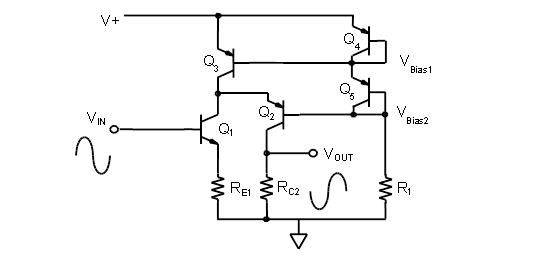
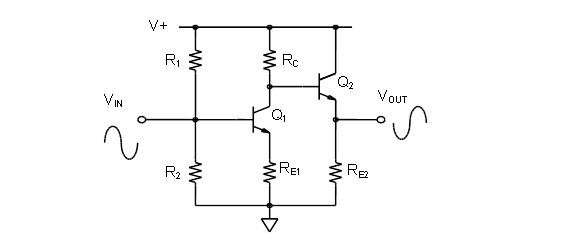
原句For example, a complementary cascade amplifier is shown in figure 10.1.4.
中文译读这是举例说明。例子的作用是把 前面的抽象概念 落到具体数值、器件或电路情形上。
补充注释学习提示:先确认这句话是在给定义、列条件、还是给结论;电路题里最常见的错误是跳过适用条件直接套公式。
原句The second common emitter stage uses a PNP transistor.
中文译读逐句译读:这句话围绕 共射极 展开;核心是在说明这些量/结构之间的定义、作用或约束关系。
补充注释共射极:BJT 反相电压增益级,输入在基极、输出在集电极。。
原句The gain calculation procedure is the same as the all-NPN cascade.
中文译读逐句译读:这是一句上下文说明,建议与前后句连读,用来补全本节的概念背景或推导条件。
补充注释学习提示:先确认这句话是在给定义、列条件、还是给结论;电路题里最常见的错误是跳过适用条件直接套公式。
原句The advantage of the complementary cascade amplifier is that the p-stage collector DC operating point tends to cancel the bias level "stacking" issue we encountered in the all n-type common emitter amplifier cascade we explored in section 10.1.2.
中文译读逐句译读:这句话围绕 共射极 展开;核心是在说明这些量/结构之间的定义、作用或约束关系。
补充注释共射极:BJT 反相电压增益级,输入在基极、输出在集电极。。
原句By using complementary devices, active level shifting can be combined with amplification.
中文译读逐句译读:这是一句上下文说明,建议与前后句连读,用来补全本节的概念背景或推导条件。
补充注释学习提示:先确认这句话是在给定义、列条件、还是给结论;电路题里最常见的错误是跳过适用条件直接套公式。
图片未下载:university:courses:electronics:text:chptr10_f5.png
原句Figure 10.1.4 complementary cascade amplifier
中文译读逐句译读:这是一句上下文说明,建议与前后句连读,用来补全本节的概念背景或推导条件。
补充注释学习提示:先确认这句话是在给定义、列条件、还是给结论;电路题里最常见的错误是跳过适用条件直接套公式。
原句A two-stage 'Complementary Pair' BJT amplifier circuit diagram is shown in figure 10.1.4.
中文译读逐句译读:这是一句上下文说明,建议与前后句连读,用来补全本节的概念背景或推导条件。
补充注释学习提示:先确认这句话是在给定义、列条件、还是给结论;电路题里最常见的错误是跳过适用条件直接套公式。
原句The rationale behind a complementary pair cascade is a problem that can arise with a cascade of similar n-type stages.
中文译读逐句译读:这是一句上下文说明,建议与前后句连读,用来补全本节的概念背景或推导条件。
补充注释学习提示:先确认这句话是在给定义、列条件、还是给结论;电路题里最常见的错误是跳过适用条件直接套公式。
原句To avoid saturation the collector voltage of each stage must be greater than the base voltage, enough greater to allow for the collector voltage signal swing.
中文译读可译为“必须/需要……”。这是约束条件,通常关系到 饱和。
补充注释饱和:不同器件上下文含义不同:BJT 饱和与 MOS 饱和不是一回事。。
原句However since the base voltage of the second stage is taken from the collector of the first stage it is inherently larger that the first stage base voltage, and the second stage collector voltage is still higher.
中文译读可译为“但是/然而……”。本句在提醒限制或例外:即使涉及 上述概念,也不能无条件套用前一句结论。
补充注释学习提示:先确认这句话是在给定义、列条件、还是给结论;电路题里最常见的错误是跳过适用条件直接套公式。
原句But this decreases the available amplitude for the amplified signal.
中文译读可译为“但是/然而……”。本句在提醒限制或例外:即使涉及 上述概念,也不能无条件套用前一句结论。
补充注释学习提示:先确认这句话是在给定义、列条件、还是给结论;电路题里最常见的错误是跳过适用条件直接套公式。
原句Adding a third stage would even further aggravate this situation.
中文译读逐句译读:这是一句上下文说明,建议与前后句连读,用来补全本节的概念背景或推导条件。
补充注释学习提示:先确认这句话是在给定义、列条件、还是给结论;电路题里最常见的错误是跳过适用条件直接套公式。
原句If a PNP second stage is used a base voltage close to the positive power supply accommodates a desirable higher first stage NPN collector voltage.
中文译读可译为“它可用于/常用于……”。本句强调 电源 的用途,设计时还要检查适用条件和限制。
补充注释电源:为电路提供能量;要同时考虑电压、电流、纹波、瞬态和保护。。
原句Moreover a third NPN stage can be cascaded at the PNP stage output without the severe voltage offset problem of a cascade of similar stages.
中文译读逐句译读:这是一句上下文说明,建议与前后句连读,用来补全本节的概念背景或推导条件。
补充注释学习提示:先确认这句话是在给定义、列条件、还是给结论;电路题里最常见的错误是跳过适用条件直接套公式。
原句Estimating the DC bias voltages and currents is simplified considerably under the assumption that the PNP base current is small compared to the NPN collector current.
中文译读逐句译读:这是一句上下文说明,建议与前后句连读,用来补全本节的概念背景或推导条件。
补充注释学习提示:先确认这句话是在给定义、列条件、还是给结论;电路题里最常见的错误是跳过适用条件直接套公式。
原句Of course this is not necessarily so but there are two reasons generally favoring such a relationship.
中文译读可译为“但是/然而……”。本句在提醒限制或例外:即使涉及 上述概念,也不能无条件套用前一句结论。
补充注释学习提示:先确认这句话是在给定义、列条件、还是给结论;电路题里最常见的错误是跳过适用条件直接套公式。
原句Considering the common DC power supply and the bias configuration one might expect intuitively that the two transistors will have roughly comparable collector currents, and a typical PNP ß of about 120 would then support the approximation.
中文译读逐句译读:这句话围绕 电源 展开;核心是在说明这些量/结构之间的定义、作用或约束关系。
补充注释电源:为电路提供能量;要同时考虑电压、电流、纹波、瞬态和保护。。
原句A sort of circular reasoning based on an enlightened self-interest suggests that a simplifying approximation relatively easy to implement in fact will be implemented so as actually to simplify the circuit design process.
中文译读逐句译读:这是一句上下文说明,建议与前后句连读,用来补全本节的概念背景或推导条件。
补充注释学习提示:先确认这句话是在给定义、列条件、还是给结论;电路题里最常见的错误是跳过适用条件直接套公式。
原句In any event the assumption can be made and subsequently justified explicitly by verifying the consistency of the assumption with values calculated using it.
中文译读逐句译读:这是一句上下文说明,建议与前后句连读,用来补全本节的概念背景或推导条件。
补充注释学习提示:先确认这句话是在给定义、列条件、还是给结论;电路题里最常见的错误是跳过适用条件直接套公式。
原句And of course adjustments can be made if and where needed in an iterative process.
中文译读逐句译读:这是一句上下文说明,建议与前后句连读,用来补全本节的概念背景或推导条件。
补充注释学习提示:先确认这句话是在给定义、列条件、还是给结论;电路题里最常见的错误是跳过适用条件直接套公式。
原句The approximation we are recommending here makes the bias calculations for each stage effectively independent of one another.
中文译读逐句译读:这是一句上下文说明,建议与前后句连读,用来补全本节的概念背景或推导条件。
补充注释学习提示:先确认这句话是在给定义、列条件、还是给结论;电路题里最常见的错误是跳过适用条件直接套公式。
原句The estimate so made can be refined by a second iteration in which rather than neglecting the PNP base current the value of this current estimated from the first iteration is used.
中文译读可译为“它可用于/常用于……”。本句强调 该结构 的用途,设计时还要检查适用条件和限制。
补充注释学习提示:先确认这句话是在给定义、列条件、还是给结论;电路题里最常见的错误是跳过适用条件直接套公式。
原句This refinement is rarely if ever necessary.
中文译读逐句译读:这是一句上下文说明,建议与前后句连读,用来补全本节的概念背景或推导条件。
补充注释学习提示:先确认这句话是在给定义、列条件、还是给结论;电路题里最常见的错误是跳过适用条件直接套公式。
原句The use of modern circuit simulation software can of course speed up this iteration process.
中文译读逐句译读:这是一句上下文说明,建议与前后句连读,用来补全本节的概念背景或推导条件。
补充注释学习提示:先确认这句话是在给定义、列条件、还是给结论;电路题里最常见的错误是跳过适用条件直接套公式。
10.2 Design Example本节译题:10.2 Design Example
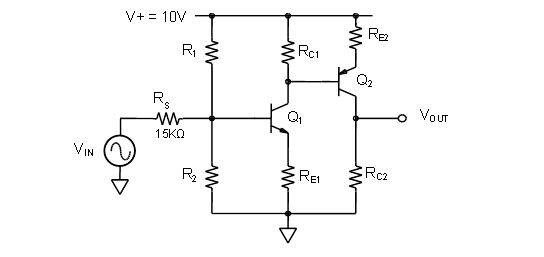
原句Design a Complementary Pair amplifier stage using 2N3904 and 2N3906 transistor's (β ˜ 120, V<sub>BE</sub> ˜ 0.7v).
中文译读逐句译读:这是一句上下文说明,建议与前后句连读,用来补全本节的概念背景或推导条件。
补充注释学习提示:先确认这句话是在给定义、列条件、还是给结论;电路题里最常见的错误是跳过适用条件直接套公式。
原句Use a supply voltage of 10 volts, and a source resistance of 15 KΩ.
中文译读逐句译读:这句话围绕 电阻 展开;核心是在说明这些量/结构之间的定义、作用或约束关系。
补充注释电阻:耗散能量并限制电流的元件参数。。
原句Estimate the DC bias voltages and currents, and compare these with the results of a computer simulation.
中文译读逐句译读:这是一句上下文说明,建议与前后句连读,用来补全本节的概念背景或推导条件。
补充注释学习提示:先确认这句话是在给定义、列条件、还是给结论;电路题里最常见的错误是跳过适用条件直接套公式。
原句Determine the small signal gain for a nominal 1 KHz signal.
中文译读逐句译读:这句话围绕 小信号 展开;核心是在说明这些量/结构之间的定义、作用或约束关系。
补充注释小信号:在直流工作点附近线性化后的增量模型,只适合小扰动。。
图片未下载:university:courses:electronics:text:chptr10_f6.png
原句Figure 10.2.1 Complementary Pair amplifier stage
中文译读逐句译读:这是一句上下文说明,建议与前后句连读,用来补全本节的概念背景或推导条件。
补充注释学习提示:先确认这句话是在给定义、列条件、还是给结论;电路题里最常见的错误是跳过适用条件直接套公式。
原句The partitioning of the stages for the bias calculation suggests the circuit shown in figure 10.2.1 performs as a cascade of two common emitter stages, each with emitter degeneration.
中文译读逐句译读:这句话围绕 共射极 展开;核心是在说明这些量/结构之间的定义、作用或约束关系。
补充注释共射极:BJT 反相电压增益级,输入在基极、输出在集电极。。
原句Consider the resistors R<sub>E1</sub> and R<sub>E2</sub> that appear in the emitter paths of the small signal parameter circuit.
中文译读逐句译读:这句话围绕 小信号 展开;核心是在说明这些量/结构之间的定义、作用或约束关系。
补充注释小信号:在直流工作点附近线性化后的增量模型,只适合小扰动。。
原句Because of the transistor current amplification this resistance transformed into the transistor base is larger by a factor of ß+1, and this typically is generally significantly larger than r<sub>e</sub>with which it is in series.
中文译读逐句译读:这句话围绕 电阻 展开;核心是在说明这些量/结构之间的定义、作用或约束关系。
补充注释电阻:耗散能量并限制电流的元件参数。。
原句Hence, roughly, an AC voltage v<sub>b</sub> at the base of the NPN device (for example) appears almost entirely across the emitter resistor.
中文译读这是举例说明。例子的作用是把 前面的抽象概念 落到具体数值、器件或电路情形上。
补充注释学习提示:先确认这句话是在给定义、列条件、还是给结论;电路题里最常见的错误是跳过适用条件直接套公式。
原句The small signal emitter current is essentially equal to the small signal collector current, and the approximate voltage gain for the first stage is -R<sub>C1</sub>/R<sub>E1</sub>.
中文译读逐句译读:这句话围绕 小信号 展开;核心是在说明这些量/结构之间的定义、作用或约束关系。
补充注释小信号:在直流工作点附近线性化后的增量模型,只适合小扰动。。
原句(Note the 180° phase shift) Similarly an estimate for the PNP stage voltage gain is -R<sub>C2</sub>/R<sub>E2</sub>.
中文译读逐句译读:这是一句上下文说明,建议与前后句连读,用来补全本节的概念背景或推导条件。
补充注释学习提示:先确认这句话是在给定义、列条件、还是给结论;电路题里最常见的错误是跳过适用条件直接套公式。
原句For the two stage cascade the gain estimate then is the product of these two gains.
中文译读逐句译读:这是一句上下文说明,建议与前后句连读,用来补全本节的概念背景或推导条件。
补充注释学习提示:先确认这句话是在给定义、列条件、还是给结论;电路题里最常见的错误是跳过适用条件直接套公式。
原句Note however there is also an input transfer loss of R<sub>B</sub>/(R<sub>B</sub> + 15kΩ).
中文译读可译为“但是/然而……”。本句在提醒限制或例外:即使涉及 上述概念,也不能无条件套用前一句结论。
补充注释学习提示:先确认这句话是在给定义、列条件、还是给结论;电路题里最常见的错误是跳过适用条件直接套公式。
原句Where R<sub>B</sub> can be approximated by the parallel combination of bias resistors R<sub>1</sub> and R<sub>2</sub>
中文译读逐句译读:这是一句上下文说明,建议与前后句连读,用来补全本节的概念背景或推导条件。
补充注释学习提示:先确认这句话是在给定义、列条件、还是给结论;电路题里最常见的错误是跳过适用条件直接套公式。
原句The first step is to estimate the DC bias currents and voltages for the design using the simplified large signal BJT models.
中文译读逐句译读:这句话围绕 大信号 展开;核心是在说明这些量/结构之间的定义、作用或约束关系。
补充注释大信号:跨越明显非线性区域的整体行为,不能直接套小信号参数。。
原句Next we use the simplified small signal parameter transistor model to estimate the AC voltage gain.
中文译读逐句译读:这句话围绕 小信号 展开;核心是在说明这些量/结构之间的定义、作用或约束关系。
补充注释小信号:在直流工作点附近线性化后的增量模型,只适合小扰动。。
原句Compare this estimate against the approximate calculation described above, as well as the computed gain.
中文译读逐句译读:这是一句上下文说明,建议与前后句连读,用来补全本节的概念背景或推导条件。
补充注释学习提示:先确认这句话是在给定义、列条件、还是给结论;电路题里最常见的错误是跳过适用条件直接套公式。
原句In this respect consider further the implication that each stage gain depends largely on the ratio of the collector resistance to the (un bypassed) emitter resistance.
中文译读逐句译读:这句话围绕 电阻 展开;核心是在说明这些量/结构之间的定义、作用或约束关系。
补充注释电阻:耗散能量并限制电流的元件参数。。
原句<note warning>This section may be incomplete due to lack of interest.</note>
中文译读逐句译读:这是一句上下文说明,建议与前后句连读,用来补全本节的概念背景或推导条件。
补充注释学习提示:先确认这句话是在给定义、列条件、还是给结论;电路题里最常见的错误是跳过适用条件直接套公式。
10.3 The Cascode共射共基/共源共栅
原句The cascode is a two-stage amplifier composed of a single transconductance amplifier (usually a common source/emitter stage) followed by a current follower (usually a common gate/base stage ).
中文译读逐句译读:这句话围绕 共射共基/共源共栅、共源极、共栅极、跨导 展开;核心是在说明这些量/结构之间的定义、作用或约束关系。
补充注释共射共基/共源共栅:通过固定下管端电压提高输出阻抗、带宽和增益,但消耗电压余量。;共源极:MOSFET 反相电压增益级,输入在栅极、输出在漏极。;共栅极:低输入阻抗、宽带 MOS 电流输入级。;跨导:输入电压变化引起输出电流变化的能力,常记为 gm。。
原句Compared to a single amplifier stage, this combination may have one or more of the following advantages: higher input-output isolation, higher input impedance, higher output impedance, higher gain or higher bandwidth.
中文译读逐句译读:这句话围绕 阻抗、带宽 展开;核心是在说明这些量/结构之间的定义、作用或约束关系。
补充注释阻抗:交流中电压与电流的复数比,包含电阻和电抗。;带宽:满足指定增益/误差条件的频率范围。。
原句In modern circuits, the cascode is often constructed from two transistors (BJTs or FETs), with one operating as a common emitter/source and the other as a common base/gate.
中文译读逐句译读:这句话围绕 共射共基/共源共栅、共射极、共基极 展开;核心是在说明这些量/结构之间的定义、作用或约束关系。
补充注释共射共基/共源共栅:通过固定下管端电压提高输出阻抗、带宽和增益,但消耗电压余量。;共射极:BJT 反相电压增益级,输入在基极、输出在集电极。;共基极:低输入阻抗、宽带电流输入级,可缓解米勒效应。。
原句The cascode improves input-output isolation (or reverse transmission) as there is less direct coupling from the output to input.
中文译读逐句译读:这句话围绕 共射共基/共源共栅 展开;核心是在说明这些量/结构之间的定义、作用或约束关系。
补充注释共射共基/共源共栅:通过固定下管端电压提高输出阻抗、带宽和增益,但消耗电压余量。。
原句This greatly reduces the Miller multiplication of stray coupling capacitance between input and output and thus contributes to a much higher bandwidth.
中文译读逐句译读:这句话围绕 电容、带宽 展开;核心是在说明这些量/结构之间的定义、作用或约束关系。
补充注释电容:储存电荷的能力;阻抗随频率升高而降低。;带宽:满足指定增益/误差条件的频率范围。。
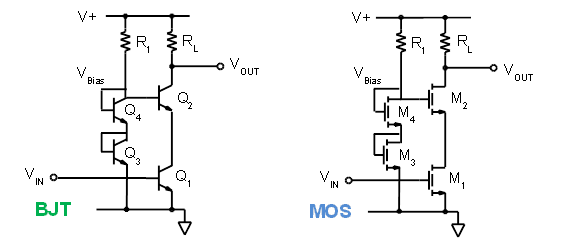
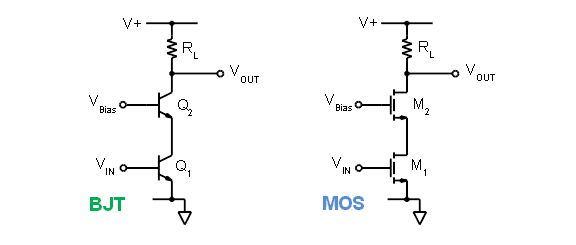
原句Figure 10.3.1 shows the basic form of the cascode amplifier with a common emitter/source amplifier as input stage, Q<sub>1</sub> or M<sub>1</sub>, driven by signal source V<sub>in</sub>.
中文译读逐句译读:这句话围绕 共射共基/共源共栅、共射极 展开;核心是在说明这些量/结构之间的定义、作用或约束关系。
补充注释共射共基/共源共栅:通过固定下管端电压提高输出阻抗、带宽和增益,但消耗电压余量。;共射极:BJT 反相电压增益级,输入在基极、输出在集电极。。
原句This input stage then drives a common base/gate amplifier, Q<sub>2</sub> or M<sub>2</sub>, as the output stage, with an output signal at V<sub>out</sub>.
中文译读逐句译读:这句话围绕 共基极 展开;核心是在说明这些量/结构之间的定义、作用或约束关系。
补充注释共基极:低输入阻抗、宽带电流输入级,可缓解米勒效应。。
图片未下载:university:courses:electronics:text:chptr10_f9.png
原句Figure 10.3.1 The Cascode Amplifier
中文译读逐句译读:这句话围绕 共射共基/共源共栅 展开;核心是在说明这些量/结构之间的定义、作用或约束关系。
补充注释共射共基/共源共栅:通过固定下管端电压提高输出阻抗、带宽和增益,但消耗电压余量。。
原句The advantage of the cascode configuration stems from the placement of an upper transistor as the load of the input transistor's output terminal (collector / drain).
中文译读逐句译读:这句话围绕 共射共基/共源共栅 展开;核心是在说明这些量/结构之间的定义、作用或约束关系。
补充注释共射共基/共源共栅:通过固定下管端电压提高输出阻抗、带宽和增益,但消耗电压余量。。
原句This upper transistor is referred to as the cascode device.
中文译读逐句译读:这句话围绕 共射共基/共源共栅 展开;核心是在说明这些量/结构之间的定义、作用或约束关系。
补充注释共射共基/共源共栅:通过固定下管端电压提高输出阻抗、带宽和增益,但消耗电压余量。。
原句Because at high frequencies the cascode transistor's base/gate is effectively grounded by DC voltage source V<sub>Bias</sub>, the cascode device's emitter / source voltage (and therefore the lower input transistor's collector / drain) is held at a more constant voltage during operation.
中文译读逐句译读:这句话围绕 共射共基/共源共栅 展开;核心是在说明这些量/结构之间的定义、作用或约束关系。
补充注释共射共基/共源共栅:通过固定下管端电压提高输出阻抗、带宽和增益,但消耗电压余量。。
原句In other words, the cascode device exhibits a low input resistance to the lower transistor, making the voltage gain seen at the collector / drain of the lower device very small, which dramatically reduces the Miller feedback capacitance from the lower transistor's collector to base or drain to gate.
中文译读逐句译读:这句话围绕 共射共基/共源共栅、电容、电阻 展开;核心是在说明这些量/结构之间的定义、作用或约束关系。
补充注释共射共基/共源共栅:通过固定下管端电压提高输出阻抗、带宽和增益,但消耗电压余量。;电容:储存电荷的能力;阻抗随频率升高而降低。;电阻:耗散能量并限制电流的元件参数。。
原句This loss of voltage gain is recovered by the cascode transistor.
中文译读逐句译读:这句话围绕 共射共基/共源共栅 展开;核心是在说明这些量/结构之间的定义、作用或约束关系。
补充注释共射共基/共源共栅:通过固定下管端电压提高输出阻抗、带宽和增益,但消耗电压余量。。
原句Thus, the cascode transistor permits the lower common emitter / source stage to operate with minimum negative (Miller) feedback, improving the bandwidth of the overall amplifier.
中文译读逐句译读:这句话围绕 共射共基/共源共栅、共射极、带宽 展开;核心是在说明这些量/结构之间的定义、作用或约束关系。
补充注释共射共基/共源共栅:通过固定下管端电压提高输出阻抗、带宽和增益,但消耗电压余量。;共射极:BJT 反相电压增益级,输入在基极、输出在集电极。;带宽:满足指定增益/误差条件的频率范围。。
原句The base or gate of the cascode device is electrically AC grounded, so charge and discharge of stray capacitance C<sub>cb</sub> or C<sub>dg</sub> between collector and base or drain and gate is simply through R<sub>L</sub> the output load, and the frequency response is affected only for frequencies above the associated RC time constant: In the case of a FET device t = C<sub>dg</sub> R<sub>D</sub>||R<sub>out</sub>, namely f = 1/(2pt), a rather high frequency because C<sub>dg</sub> is small.
中文译读逐句译读:这句话围绕 共射共基/共源共栅、电容、频率响应 展开;核心是在说明这些量/结构之间的定义、作用或约束关系。
补充注释共射共基/共源共栅:通过固定下管端电压提高输出阻抗、带宽和增益,但消耗电压余量。;电容:储存电荷的能力;阻抗随频率升高而降低。;频率响应:电路增益和相位随频率变化的关系。。
原句That is, the upper FET gate does not suffer from Miller multiplication of C<sub>dg</sub>.
中文译读逐句译读:这是一句上下文说明,建议与前后句连读,用来补全本节的概念背景或推导条件。
补充注释学习提示:先确认这句话是在给定义、列条件、还是给结论;电路题里最常见的错误是跳过适用条件直接套公式。
原句If the cascode device stage were operated alone using its emitter or source as input node (i.e. common base/gate configuration), it would have good voltage gain and wide bandwidth.
中文译读逐句译读:这句话围绕 共射共基/共源共栅、共基极、带宽 展开;核心是在说明这些量/结构之间的定义、作用或约束关系。
补充注释共射共基/共源共栅:通过固定下管端电压提高输出阻抗、带宽和增益,但消耗电压余量。;共基极:低输入阻抗、宽带电流输入级,可缓解米勒效应。;带宽:满足指定增益/误差条件的频率范围。。
原句However, its low input impedance would limit its usefulness to very low impedance voltage drivers.
中文译读可译为“但是/然而……”。本句在提醒限制或例外:即使涉及 阻抗,也不能无条件套用前一句结论。
补充注释阻抗:交流中电压与电流的复数比,包含电阻和电抗。。
原句Adding the lower common emitter/source stage results in an increased input impedance, allowing the cascode stage to be driven by a higher impedance source.
中文译读逐句译读:这句话围绕 共射共基/共源共栅、共射极、阻抗 展开;核心是在说明这些量/结构之间的定义、作用或约束关系。
补充注释共射共基/共源共栅:通过固定下管端电压提高输出阻抗、带宽和增益,但消耗电压余量。;共射极:BJT 反相电压增益级,输入在基极、输出在集电极。;阻抗:交流中电压与电流的复数比,包含电阻和电抗。。
原句If one were to replace the upper device with a typical resistive load, and take the output from the input transistor's collector or drain the common emitter/source configuration would offer the same input impedance as the cascode configuration, but the cascode configuration would offer a potentially greater gain and much greater bandwidth.
中文译读可译为“但是/然而……”。本句在提醒限制或例外:即使涉及 共射共基/共源共栅、共射极、阻抗、带宽,也不能无条件套用前一句结论。
补充注释共射共基/共源共栅:通过固定下管端电压提高输出阻抗、带宽和增益,但消耗电压余量。;共射极:BJT 反相电压增益级,输入在基极、输出在集电极。;阻抗:交流中电压与电流的复数比,包含电阻和电抗。;带宽:满足指定增益/误差条件的频率范围。。
原句As shown, the cascode circuit using two stacked FET's imposes some restrictions on the two FET's-namely, the upper FET must be biased so its source voltage is high enough (the lower FET drain voltage may swing too low, causing it to leave saturation).
中文译读可译为“必须/需要……”。这是约束条件,通常关系到 共射共基/共源共栅、饱和。
补充注释共射共基/共源共栅:通过固定下管端电压提高输出阻抗、带宽和增益,但消耗电压余量。;饱和:不同器件上下文含义不同:BJT 饱和与 MOS 饱和不是一回事。。
原句Insurance of this condition for FET's requires careful selection for the pair, or special biasing of the upper FET gate, increasing cost.
中文译读逐句译读:这是一句上下文说明,建议与前后句连读,用来补全本节的概念背景或推导条件。
补充注释学习提示:先确认这句话是在给定义、列条件、还是给结论;电路题里最常见的错误是跳过适用条件直接套公式。
原句The cascode circuit can be built using the same type transistors, or even mixed with one FET and one BJT.
中文译读逐句译读:这句话围绕 共射共基/共源共栅 展开;核心是在说明这些量/结构之间的定义、作用或约束关系。
补充注释共射共基/共源共栅:通过固定下管端电压提高输出阻抗、带宽和增益,但消耗电压余量。。
原句In the latter case, the BJT must be the upper transistor; otherwise, the (lower) BJT will always saturate (unless extraordinary steps are taken to bias it).
中文译读可译为“必须/需要……”。这是约束条件,通常关系到 安全工作范围、精度或稳定性。
补充注释学习提示:先确认这句话是在给定义、列条件、还是给结论;电路题里最常见的错误是跳过适用条件直接套公式。
10.3.2 Cascode biasing techniques共射共基/共源共栅
图片未下载:university:courses:electronics:text:chptr10_f10.png
原句Figure 10.3.2 cascode biasing techniques
中文译读逐句译读:这句话围绕 共射共基/共源共栅 展开;核心是在说明这些量/结构之间的定义、作用或约束关系。
补充注释共射共基/共源共栅:通过固定下管端电压提高输出阻抗、带宽和增益,但消耗电压余量。。
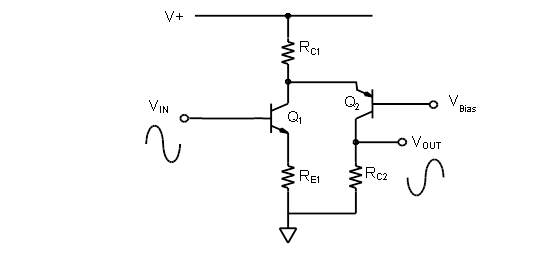
原句Let us suppose that I need to build an amplifier that operates from a 100 volt power supply, however the transistors that I have available have a collector to emitter breakdown voltage (BV<sub>CEO</sub>) of only 25 volts.
中文译读可译为“但是/然而……”。本句在提醒限制或例外:即使涉及 电源,也不能无条件套用前一句结论。
补充注释电源:为电路提供能量;要同时考虑电压、电流、纹波、瞬态和保护。。
原句A cascode or as series of cascodes may also be combined with a voltage ladder to form a high voltage transistor.
中文译读逐句译读:这句话围绕 共射共基/共源共栅 展开;核心是在说明这些量/结构之间的定义、作用或约束关系。
补充注释共射共基/共源共栅:通过固定下管端电压提高输出阻抗、带宽和增益,但消耗电压余量。。
原句The input transistor may be any low-BV<sub>CEO</sub> type, while the others, acting as stacked linear series voltage regulators, must be able to withstand a sizeable fraction of the supply voltage.
中文译读可译为“必须/需要……”。这是约束条件,通常关系到 稳压器。
补充注释稳压器:在输入、负载变化时维持输出电压,设计要看压差、热耗和稳定性。。
原句The amplifier shown in figure 10.3.3.
中文译读逐句译读:这是一句上下文说明,建议与前后句连读,用来补全本节的概念背景或推导条件。
补充注释学习提示:先确认这句话是在给定义、列条件、还是给结论;电路题里最常见的错误是跳过适用条件直接套公式。
原句Note that, for a large output voltage swing, their base voltages should not be bypassed to ground by capacitors, and the uppermost ladder resistor should be able to withstand the full supply voltage.
中文译读本句是学习目标:完成这一部分后,需要能够解释或运用 文中概念。
补充注释学习提示:先确认这句话是在给定义、列条件、还是给结论;电路题里最常见的错误是跳过适用条件直接套公式。
10.3.4 The Folded Cascode共射共基/共源共栅 / 折叠共射共基/折叠共源共栅
原句Rather than stacking the transistors one on top of the other, which can reduce or limit the available signal swing, it is often advantageous to "fold" the cascode device as shown in figure 10.3.5.
中文译读逐句译读:这句话围绕 共射共基/共源共栅 展开;核心是在说明这些量/结构之间的定义、作用或约束关系。
补充注释共射共基/共源共栅:通过固定下管端电压提高输出阻抗、带宽和增益,但消耗电压余量。。
图片未下载:university:courses:electronics:text:chptr10_f11.png
原句Figure 10.3.5 Simple folded cascode amplifier
中文译读逐句译读:这句话围绕 共射共基/共源共栅、折叠共射共基/折叠共源共栅 展开;核心是在说明这些量/结构之间的定义、作用或约束关系。
补充注释共射共基/共源共栅:通过固定下管端电压提高输出阻抗、带宽和增益,但消耗电压余量。;折叠共射共基/折叠共源共栅:把信号电流折到另一电源轨,常用于改善输入共模范围和电压余量。。
10.3.5 The Folded Cascode biasing techniques共射共基/共源共栅 / 折叠共射共基/折叠共源共栅
图片未下载:university:courses:electronics:text:chptr10_f12.png
原句Figure 10.3.6
中文译读逐句译读:这是一句上下文说明,建议与前后句连读,用来补全本节的概念背景或推导条件。
补充注释学习提示:先确认这句话是在给定义、列条件、还是给结论;电路题里最常见的错误是跳过适用条件直接套公式。
10.3.6 The Shunt Feedback Cascode共射共基/共源共栅
原句Additionally, a variation on the cascode amplifier combines it with the shunt-feedback.
中文译读逐句译读:这句话围绕 共射共基/共源共栅 展开;核心是在说明这些量/结构之间的定义、作用或约束关系。
补充注释共射共基/共源共栅:通过固定下管端电压提高输出阻抗、带宽和增益,但消耗电压余量。。
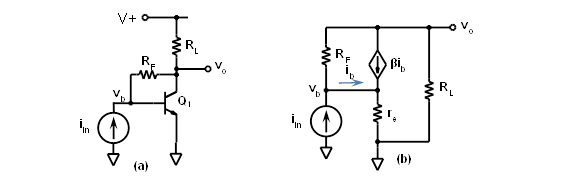
原句The basic shunt feedback circuit is shown in figure 10.3.7 (a), and with BJT T model (b).
中文译读逐句译读:这是一句上下文说明,建议与前后句连读,用来补全本节的概念背景或推导条件。
补充注释学习提示:先确认这句话是在给定义、列条件、还是给结论;电路题里最常见的错误是跳过适用条件直接套公式。
图片未下载:university:courses:electronics:text:chptr10_f13.png
原句Figure 10.3.7 The shunt feedback common emitter amplifier
中文译读逐句译读:这句话围绕 共射极 展开;核心是在说明这些量/结构之间的定义、作用或约束关系。
补充注释共射极:BJT 反相电压增益级,输入在基极、输出在集电极。。
原句It is a transresistance (current in, voltage out) amplifier, with a transresistance of:
中文译读逐句译读:这句话围绕 电阻 展开;核心是在说明这些量/结构之间的定义、作用或约束关系。
补充注释电阻:耗散能量并限制电流的元件参数。。
原句<m> v_o/i_in =-alpha R_F + r_e, R_L ⇒ infty </m>
中文译读逐句译读:这是一句上下文说明,建议与前后句连读,用来补全本节的概念背景或推导条件。
补充注释学习提示:先确认这句话是在给定义、列条件、还是给结论;电路题里最常见的错误是跳过适用条件直接套公式。
原句if R<sub>L</sub> approaches being a current source (is large relative to R<sub>F</sub> ).
中文译读逐句译读:这是一句上下文说明,建议与前后句连读,用来补全本节的概念背景或推导条件。
补充注释学习提示:先确认这句话是在给定义、列条件、还是给结论;电路题里最常见的错误是跳过适用条件直接套公式。
原句For R<sub>F</sub> >> r<sub>e</sub> and α ≈ 1, the transresistance is approximately R<sub>F</sub>.
中文译读逐句译读:这句话围绕 电阻 展开;核心是在说明这些量/结构之间的定义、作用或约束关系。
补充注释电阻:耗散能量并限制电流的元件参数。。
原句The shunt feedback amplifier can be used for high-speed applications.
中文译读可译为“它可用于/常用于……”。本句强调 该结构 的用途,设计时还要检查适用条件和限制。
补充注释学习提示:先确认这句话是在给定义、列条件、还是给结论;电路题里最常见的错误是跳过适用条件直接套公式。
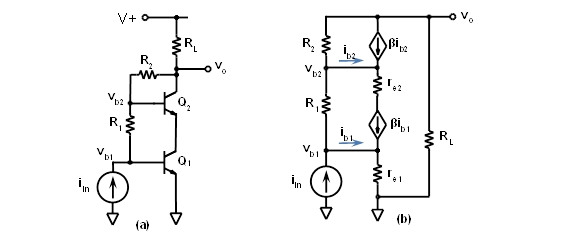
原句When combined with the cascode, the resulting amplifier - the shunt feedback cascode - is shown in figure 10.3.8 (a) with the small-signal model in (b).
中文译读逐句译读:这句话围绕 共射共基/共源共栅 展开;核心是在说明这些量/结构之间的定义、作用或约束关系。
补充注释共射共基/共源共栅:通过固定下管端电压提高输出阻抗、带宽和增益,但消耗电压余量。。
图片未下载:university:courses:electronics:text:chptr10_f14.png
原句Figure 10.3.8 The shunt feedback cascode
中文译读逐句译读:这句话围绕 共射共基/共源共栅 展开;核心是在说明这些量/结构之间的定义、作用或约束关系。
补充注释共射共基/共源共栅:通过固定下管端电压提高输出阻抗、带宽和增益,但消耗电压余量。。
原句R<sub>1</sub> in series with R<sub>2</sub> is basically R<sub>F</sub>.
中文译读逐句译读:这是一句上下文说明,建议与前后句连读,用来补全本节的概念背景或推导条件。
补充注释学习提示:先确认这句话是在给定义、列条件、还是给结论;电路题里最常见的错误是跳过适用条件直接套公式。
原句Because the current through R<sub>2</sub> loses both base currents before being returned to the input node, both a<sub>Q1</sub> and a<sub>Q2</sub> appear in the second gain term.
中文译读逐句译读:这是一句上下文说明,建议与前后句连读,用来补全本节的概念背景或推导条件。
补充注释学习提示:先确认这句话是在给定义、列条件、还是给结论;电路题里最常见的错误是跳过适用条件直接套公式。
原句Unlike the simple shunt feedback stage, C<sub>bc</sub> of either BJT does not shunt R<sub>F</sub>, and is divided between transistors.
中文译读逐句译读:这是一句上下文说明,建议与前后句连读,用来补全本节的概念背景或推导条件。
补充注释学习提示:先确认这句话是在给定义、列条件、还是给结论;电路题里最常见的错误是跳过适用条件直接套公式。
原句The voltage at the base of Q<sub>2</sub> varies, as the midpoint of an R<sub>1</sub>, R<sub>2</sub> voltage divider, and Q<sub>2</sub> is not a purely common base configuration.
中文译读逐句译读:这句话围绕 共基极 展开;核心是在说明这些量/结构之间的定义、作用或约束关系。
补充注释共基极:低输入阻抗、宽带电流输入级,可缓解米勒效应。。
原句The two feedback resistor values can be chosen to adjust the extent of the Miller effect across the base collector junctions of the transistors.
中文译读逐句译读:这句话围绕 米勒效应 展开;核心是在说明这些量/结构之间的定义、作用或约束关系。
补充注释米勒效应:输入输出之间的电容在反相增益作用下等效放大,降低高频带宽。。
原句If speed is not the most important design parameter, but voltage is, then this amplifier provides the advantage of dividing the collector voltage across two series BJTs.
中文译读可译为“但是/然而……”。本句在提醒限制或例外:即使涉及 上述概念,也不能无条件套用前一句结论。
补充注释学习提示:先确认这句话是在给定义、列条件、还是给结论;电路题里最常见的错误是跳过适用条件直接套公式。
原句If R<sub>1</sub> = R<sub>2</sub>, then each BJT need have only about half the breakdown voltage of a single-BJT amplifier.
中文译读逐句译读:这是一句上下文说明,建议与前后句连读,用来补全本节的概念背景或推导条件。
补充注释学习提示:先确认这句话是在给定义、列条件、还是给结论;电路题里最常见的错误是跳过适用条件直接套公式。
原句Again, the cascode presents an advantage for high-voltage applications.
中文译读逐句译读:这句话围绕 共射共基/共源共栅 展开;核心是在说明这些量/结构之间的定义、作用或约束关系。
补充注释共射共基/共源共栅:通过固定下管端电压提高输出阻抗、带宽和增益,但消耗电压余量。。
原句Yet another shunt feedback cascode variation uses a single feedback resistor, as shown in figure 10.3.8 (a), along with a flow graph (for feedback analysis) of the dynamic model of the circuit (b).
中文译读逐句译读:这句话围绕 共射共基/共源共栅 展开;核心是在说明这些量/结构之间的定义、作用或约束关系。
补充注释共射共基/共源共栅:通过固定下管端电压提高输出阻抗、带宽和增益,但消耗电压余量。。
原句(Z<sub>F</sub> is R<sub>F</sub> in parallel with C<sub>F</sub> and Z<sub>L</sub> is R<sub>L</sub> in parallel with C<sub>L</sub>.) C<sub>F</sub> is added to provide an additional parameter for adjusting the dynamic amplifier response.
中文译读逐句译读:这是一句上下文说明,建议与前后句连读,用来补全本节的概念背景或推导条件。
补充注释学习提示:先确认这句话是在给定义、列条件、还是给结论;电路题里最常见的错误是跳过适用条件直接套公式。
原句The transistor gain bandwidth time constant, ?<sub>T</sub>, is related to f<sub>T</sub> by:
中文译读逐句译读:这句话围绕 增益带宽积、带宽 展开;核心是在说明这些量/结构之间的定义、作用或约束关系。
补充注释增益带宽积:单极点补偿运放中闭环带宽与闭环增益大致互相折中。;带宽:满足指定增益/误差条件的频率范围。。
原句For Rf Cf >> τ<sub>T1</sub>, τ<sub>T2</sub>, then the poles of the amplifier response follow a circular s-plane locus as t<sub>T2</sub> is varied.
中文译读逐句译读:这是一句上下文说明,建议与前后句连读,用来补全本节的概念背景或推导条件。
补充注释学习提示:先确认这句话是在给定义、列条件、还是给结论;电路题里最常见的错误是跳过适用条件直接套公式。
原句As Q<sub>2</sub> is made a slower transistor, the closed-loop poles converge, then split off the real axis and follow a circular path to the origin.
中文译读逐句译读:这是一句上下文说明,建议与前后句连读,用来补全本节的概念背景或推导条件。
补充注释学习提示:先确认这句话是在给定义、列条件、还是给结论;电路题里最常见的错误是跳过适用条件直接套公式。
原句Variation of τ<sub>T1</sub>, Cf or C<sub>L</sub> follows a vertical locus.
中文译读逐句译读:这是一句上下文说明,建议与前后句连读,用来补全本节的概念背景或推导条件。
补充注释学习提示:先确认这句话是在给定义、列条件、还是给结论;电路题里最常见的错误是跳过适用条件直接套公式。
原句As any one of them increases in value, the poles move vertically toward the real axis, then split along the axis, heading for the origin and negative infinity.
中文译读逐句译读:这是一句上下文说明,建议与前后句连读,用来补全本节的概念背景或推导条件。
补充注释学习提示:先确认这句话是在给定义、列条件、还是给结论;电路题里最常见的错误是跳过适用条件直接套公式。
原句The dynamic input impedance of this amplifier is interesting.
中文译读逐句译读:这句话围绕 阻抗 展开;核心是在说明这些量/结构之间的定义、作用或约束关系。
补充注释阻抗:交流中电压与电流的复数比,包含电阻和电抗。。
原句For infinite Rf and ß<sub>Q1</sub>, the input resistance should appear to be infinite but it is not.
中文译读可译为“但是/然而……”。本句在提醒限制或例外:即使涉及 电阻,也不能无条件套用前一句结论。
补充注释电阻:耗散能量并限制电流的元件参数。。
原句The static input resistance is infinite, but not the dynamic resistance.
中文译读可译为“但是/然而……”。本句在提醒限制或例外:即使涉及 电阻,也不能无条件套用前一句结论。
补充注释电阻:耗散能量并限制电流的元件参数。。
原句This unusual phenomenon will be the subject of a future article.
中文译读逐句译读:这是一句上下文说明,建议与前后句连读,用来补全本节的概念背景或推导条件。
补充注释学习提示:先确认这句话是在给定义、列条件、还是给结论;电路题里最常见的错误是跳过适用条件直接套公式。
原句(Hint: apply a 1-V step to the input and trace through the effects.
中文译读逐句译读:这是一句上下文说明,建议与前后句连读,用来补全本节的概念背景或推导条件。
补充注释学习提示:先确认这句话是在给定义、列条件、还是给结论;电路题里最常见的错误是跳过适用条件直接套公式。
原句As the collector node responds to the input step (but not as a step, because of capacitance), then what is the current through Cf?
中文译读可译为“但是/然而……”。本句在提醒限制或例外:即使涉及 电容,也不能无条件套用前一句结论。
补充注释电容:储存电荷的能力;阻抗随频率升高而降低。。
原句If it is constant, then what impedance does a constant current due to a constant input voltage appear as at the input node?)
中文译读逐句译读:这句话围绕 阻抗 展开;核心是在说明这些量/结构之间的定义、作用或约束关系。
补充注释阻抗:交流中电压与电流的复数比,包含电阻和电抗。。
10.3.7 Cascode Review共射共基/共源共栅
原句The cascode amplifier, with its variations, is a key element in the circuit designer's tool kit of useful circuits.
中文译读逐句译读:这句话围绕 共射共基/共源共栅 展开;核心是在说明这些量/结构之间的定义、作用或约束关系。
补充注释共射共基/共源共栅:通过固定下管端电压提高输出阻抗、带宽和增益,但消耗电压余量。。
原句It has advantages for increasing bandwidth and for high-voltage amplifier applications.
中文译读逐句译读:这句话围绕 带宽 展开;核心是在说明这些量/结构之间的定义、作用或约束关系。
补充注释带宽:满足指定增益/误差条件的频率范围。。
原句A cascode amplifier consists of a common emitter stage loaded by the emitter of a common base stage.
中文译读逐句译读:这句话围绕 共射共基/共源共栅、共射极、共基极 展开;核心是在说明这些量/结构之间的定义、作用或约束关系。
补充注释共射共基/共源共栅:通过固定下管端电压提高输出阻抗、带宽和增益,但消耗电压余量。;共射极:BJT 反相电压增益级,输入在基极、输出在集电极。;共基极:低输入阻抗、宽带电流输入级,可缓解米勒效应。。
原句The heavily loaded common emitter stage has a low gain of 1, overcoming the Miller effect
中文译读逐句译读:这句话围绕 共射极、米勒效应 展开;核心是在说明这些量/结构之间的定义、作用或约束关系。
补充注释共射极:BJT 反相电压增益级,输入在基极、输出在集电极。;米勒效应:输入输出之间的电容在反相增益作用下等效放大,降低高频带宽。。
原句A cascode amplifier has a high gain, moderately high input impedance, a high output impedance, and a high bandwidth.
中文译读逐句译读:这句话围绕 共射共基/共源共栅、阻抗、带宽 展开;核心是在说明这些量/结构之间的定义、作用或约束关系。
补充注释共射共基/共源共栅:通过固定下管端电压提高输出阻抗、带宽和增益,但消耗电压余量。;阻抗:交流中电压与电流的复数比,包含电阻和电抗。;带宽:满足指定增益/误差条件的频率范围。。
原句Additional notes on Level Shifting in multi-stage amplifiers
中文译读逐句译读:这是一句上下文说明,建议与前后句连读,用来补全本节的概念背景或推导条件。
补充注释学习提示:先确认这句话是在给定义、列条件、还是给结论;电路题里最常见的错误是跳过适用条件直接套公式。
原句In multi-stage amplifiers on integrated circuits, coupling capacitors between stages are almost always not used because they cannot be made large enough for reasonable low-frequency operation.
中文译读逐句译读:这是一句上下文说明,建议与前后句连读,用来补全本节的概念背景或推导条件。
补充注释学习提示:先确认这句话是在给定义、列条件、还是给结论;电路题里最常见的错误是跳过适用条件直接套公式。
原句Thus, stages are DC-coupled.
中文译读逐句译读:这是一句上下文说明,建议与前后句连读,用来补全本节的概念背景或推导条件。
补充注释学习提示:先确认这句话是在给定义、列条件、还是给结论;电路题里最常见的错误是跳过适用条件直接套公式。
原句This means that voltage offsets like V<sub>BE</sub> drops between stages can start to add up... stages referred to as level shifters can be used to compensate where necessary.
中文译读可译为“它可用于/常用于……”。本句强调 该结构 的用途,设计时还要检查适用条件和限制。
补充注释学习提示:先确认这句话是在给定义、列条件、还是给结论;电路题里最常见的错误是跳过适用条件直接套公式。
原句Emitter or source followers provide a DC level shift of V<sub>BE</sub> or V<sub>GS</sub> and can be inserted between stages with signal loss as their gain is very close to +1.
中文译读逐句译读:这句话围绕 源极跟随器 展开;核心是在说明这些量/结构之间的定义、作用或约束关系。
补充注释源极跟随器:MOS 缓冲级,输出大约跟随栅极电压但差一个 VGS。。
原句By using PNP and NPN or PMOS and NMOS transistors, the direction of the level shift per shifter can be either up or down in voltage.
中文译读逐句译读:这是一句上下文说明,建议与前后句连读,用来补全本节的概念背景或推导条件。
补充注释学习提示:先确认这句话是在给定义、列条件、还是给结论;电路题里最常见的错误是跳过适用条件直接套公式。
原句Another typical level shifter might be simply a degenerated common emitter amplifier (it can provide gain or simply act as an inverting buffer if R<sub>E</sub> = R<sub>C</sub>).
中文译读逐句译读:这句话围绕 共射极 展开;核心是在说明这些量/结构之间的定义、作用或约束关系。
补充注释共射极:BJT 反相电压增益级,输入在基极、输出在集电极。。
原句The choice of R<sub>C</sub> "programs" the quiescent collector voltage of the level shifter and can thus be used to "center" the output voltage of an op amp so that it can swing both positive and negative from its quiescent point.
中文译读可译为“它可用于/常用于……”。本句强调 运放 的用途,设计时还要检查适用条件和限制。
补充注释运放:高增益差分放大器;分析时先确认是否处于负反馈线性区。。
原句Return to Previous Chapter
中文译读逐句译读:这是一句上下文说明,建议与前后句连读,用来补全本节的概念背景或推导条件。
补充注释学习提示:先确认这句话是在给定义、列条件、还是给结论;电路题里最常见的错误是跳过适用条件直接套公式。
原句Go to Next Chapter
中文译读逐句译读:这是一句上下文说明,建议与前后句连读,用来补全本节的概念背景或推导条件。
补充注释学习提示:先确认这句话是在给定义、列条件、还是给结论;电路题里最常见的错误是跳过适用条件直接套公式。
原句Return to Table of Contents
中文译读逐句译读:这是一句上下文说明,建议与前后句连读,用来补全本节的概念背景或推导条件。
补充注释学习提示:先确认这句话是在给定义、列条件、还是给结论;电路题里最常见的错误是跳过适用条件直接套公式。